Hiring Season Is Ending, Here's How to Stand Out and Get Hired Before It's Too Late
Hiring season in the built environment doesn’t quite operate like other industries. Paired with the heightened level of competition, global economy and an outdated system, this often puts graduates at a disadvantage. Typically, Part 1’s would finish university and look to replace those already working in practice on their ‘year out’ by September. But more and more practices are opting for a leaner setup that is influenced by the work coming In. Say if a medium-sized practices gains planning approval for a large commercial project, they may look to hire specifically to fill that gap to ensure the rest of their team isn’t overloaded (an issue that has noble intentions but doesn’t quite follow through). This is also likely why we’ve been seeing mass redundancies across the sector with big names laying off younger staff members. It’s not a pretty practice by any means.
This means we’ve now arrived at a stage where practices don’t necessarily have a hiring ‘season’ and therefore all jobs are up for grabs. But because there are so few, there is an insane level of competition, with around 200 applicants as a starting minimum for junior roles in London. A recruiter once told me, ‘more than half the practices who are hiring, are likely not advertising’. This may be because they’re using recruitment services or already have an extensive pool of candidates who apply speculatively.
However, let’s say by some chance you catch on early and begin to research studios and get an understanding of the work or the practices you align with. Perhaps you even put together a portfolio with a placeholder for the work that’s about to come. Maybe you even send out a few applications as ‘early’ as April. But there’s little chance you’re hearing back. This is because your application is likely generic. Now I don’t mean that the quality of your work is generic - because I’ve seen over hundreds of portfolios and more often than not, everyone has great work. What’s generic about your application, is the way you’re communcating it.
Discipline
Too little too late. It’s often the case with many graduates who get caught up in the panic of deadlines and get burnt out by the end of the academic year. Then they realise there’s actually a whole world out there and they were supposed to be preparing for that too. It’s a lot, I know. But there’s this unspoken competitiveness that creeps in with the question ‘so what are you doing after graduation?’. I remember hearing how my peers had jobs lined up at the Heatherwicks and Foster’s of the world and it suddenly seemed like I wasn’t doing enough.
Awareness wasn’t necessarily the issue here. It was discipline, combined with tunnel vision. I’m the type of person who really means it when I say organisational skils are a strength of mine. I’m writing this post as a 5-part series that I’ll drip feed to my audience across platforms weeks in advance. I may have stumbled a little during my time in architecture school, but I always finished strong. Most people might see this as ‘working better under pressure’. But I don’t work better, I work in a healthier way that requires a lot of discipline and setting boundaries early on.
Then the tunnel vision comes in. In an effort to do your best at university and get the highest grade or deliver a project you’re really proud of, the last thing you’re thinking about is what 9-5 you’re going to be working at in the next few months. This tunnel vision turns into weeks and months of just trying to get over the line and then giving yourself time to rest and reset, which should absolutely be the case. But, and as it was in my experience, aside from a couple of vague lectures on employability skills and how to put together the most generic CV, no one is holding your hand and telling you to start applying. I am.
Design Signature
You’ve probably clicked on this post because the fear set in a little and you questioned whether you’ve missed hiring season. In a sense, yes. If you’re not already actively applying then it’s likely you’re losing out on opportunities. I realise this sounds very much like joining the rat race because that’s all you can do, but there are ways to stand out and not get lost in the massive ocean of candidates.

When I speak to graduates who attend Open Studios, there will always be a few stand out individuals who have exceptional work. It’s incredibly detailed or tells a lovely story that is fuelled by their personal experiences or issues in the world that they’re addressing. They’ll come with high-polished work, bound neatly into a portfolio that feels like an artifact. Then when you speak to these individuals, you hear how they’ve been applying for more than a year, competing with this year’s cohort or not hearing back after interviews. So, good work is also not enough of a majority factor when it comes to getting hired.
What I have identified is the core of any brand. Some call it a USP or a UVP, a mission statement, an ethos, a manifesto, an unfair advantage if you will. Whatever you want to call it, and here I’m calling it your design signature, it all boils down to the same thing really. It’s the elements of the way you think, design that are unique only to you. Let’s face it, every architecture is going to be ‘proficient in (insert software of choice)’ or ‘skilled at model-making’. But that hiring manager isn’t looking for a tick box set of skills. They’re looking for that added advantage that perhaps their team currently lacks or an area that they want to explore as a practice to gain an upper hand.
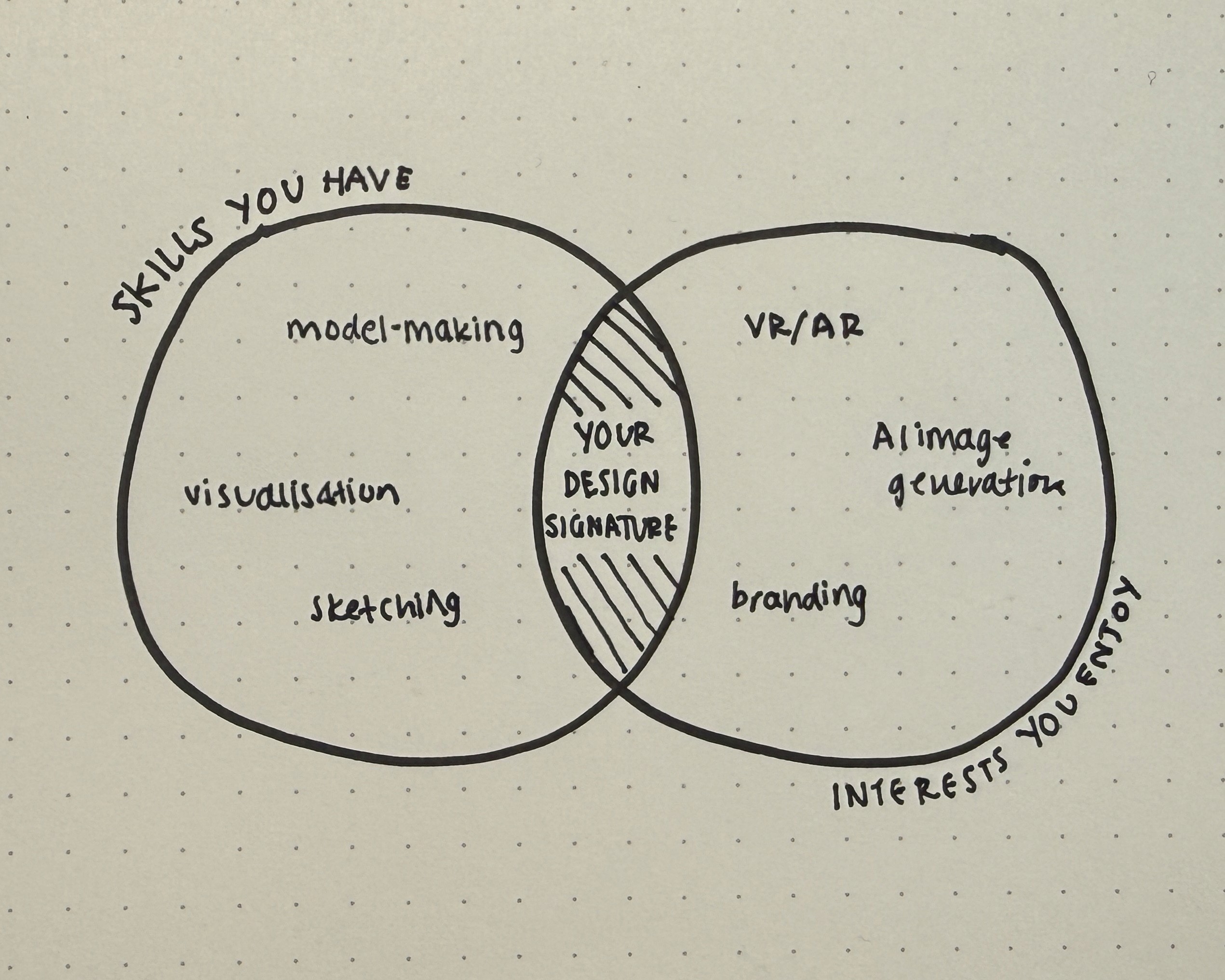
This could be something as simple as having experience using VR and being able to translate spaces into this form of design exploration. It could also be as complex as combining innovative 3D printing methods with materials that are low-carbon. I often explain a design signature as the intersection of the venn diagram of the skills you enjoy and the interests you have. For me this was being able to brand my proposal as a utopian city, creating marketing assets like posters and campaigns to further the story behind why this carpet city is the next big thing. I branded each district of my masterplan, combining my extensive research into Mughal miniatures with classic storytelling techniques.

Communication
However the last step in communicating that design signature is the make or break for me when it comes to being generic and truly standing out of the crowd. Most advice out there will tell you to use architectural jargon or ‘do something new’ and yet we see the same retrofit projects that have cute little biodiversity gardens just like every other student from another university. I don’t actually think your work has to be exceptional either but the way you communicate it can be a game changer.
For too long, we’ve seen and stereotyped architects as narcissistic creatures who are only concerned with the aesthetics of a space or building. But if we look at telling stories like salespeople or like authors, it can provide a new lens on how we can both grab people’s attention and keep them hooked. It’s become the basis for the content we consume and the advertisements we’re attracted to. Similarly, this ‘hook’ can be the basis of your design signature.
Draw the venn diagram and start to critically evaluate what your design signature is. Ask your peers as to what they think you’ve done better than anyone else in the studio. The more you sit to reflect and distill down to your design signature the closer you can get to really leaning into it. This only works if you’re disgustingly specific. And you should communicate it that way too. When applying to practices like Make or Morris+Company, you should know going in that model-making is a big aspect of their process. Therefore, is that something you can align yourself with, or perhaps offer an advantage in another area? Your design signature can be communicated through the personal statement you write in your CV or at the beginning of your cover letter (more on that soon). But it should be fuelled by your design thinking, process or the way that you combine elements.
The reason this is the first of a 5-part series is because your design signature underpins everything else. The way that you cater for shortened attention spans or getting comfortable with achieving a level of momentum and even talking about yourself to an employer.